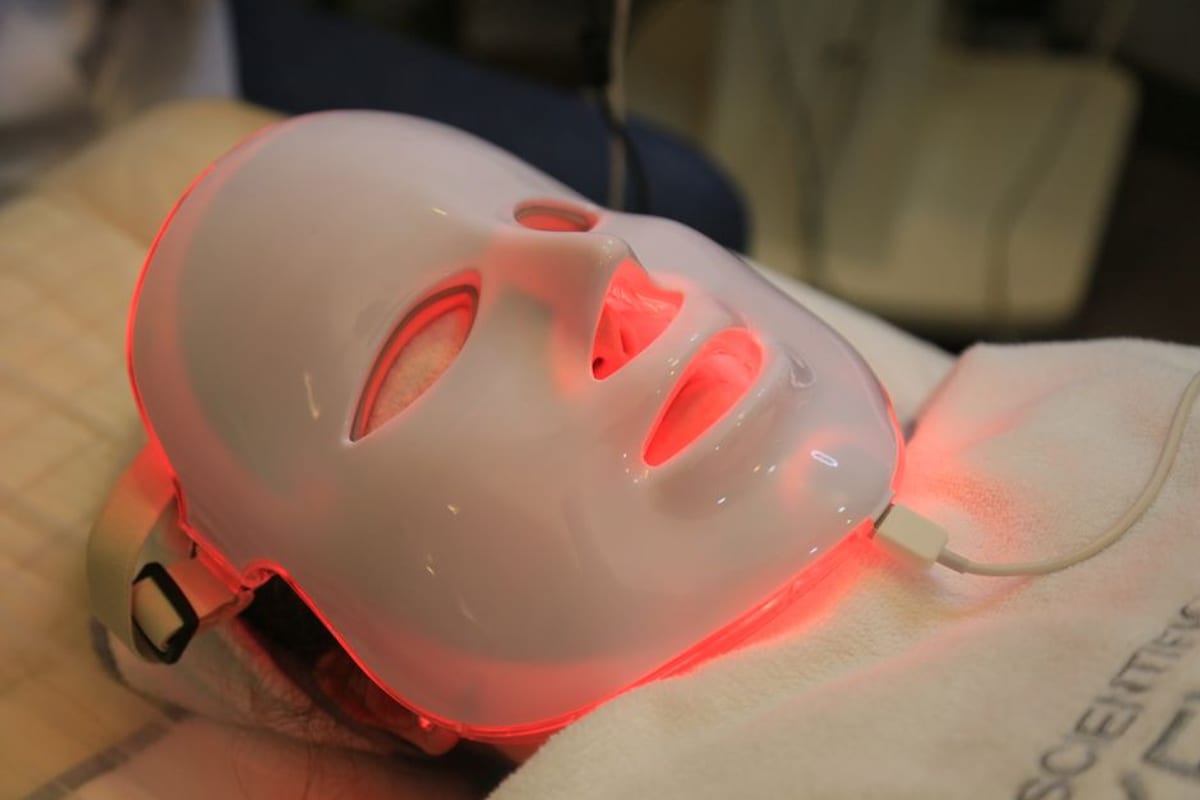
LED masks look identical to each other and cost anywhere from £40 to £400. That gap isn’t branding alone, and understanding what creates it is most of what you need before buying one.
What the light is meant to do
Different wavelengths reach different depths and are studied for different purposes.
Red light, roughly 630 to 660 nanometres, penetrates a few millimetres and is the wavelength most studied for skin. The proposed mechanism involves mitochondria in skin cells responding to specific wavelengths and increasing energy production. Studies exist on collagen and on wound healing.
Near-infrared, around 830 to 850 nm, reaches deeper. Frequently paired with red in the same device.
Blue light, around 415 nm, is antibacterial and studied specifically for acne. It targets the bacteria involved in breakouts rather than anything to do with ageing.
Other colours appear on cheaper multi-colour masks. Green, yellow and purple have far less supporting evidence than red and blue, and their presence is largely a feature-count decision.
What the evidence actually shows
Better than most home beauty devices, and weaker than the advertising suggests.
There’s genuine research on red light and collagen, some of it independent, and light therapy has a long clinical history in dermatology. The mechanism is real.
The gap sits between clinical devices and home ones. Professional equipment delivers considerably higher irradiance than a consumer mask. Studies conducted on clinical devices get cited in marketing for home ones, and the two aren’t equivalent.
Blue light for acne has reasonable support. It’s also worth knowing it addresses one contributing factor and doesn’t replace treatment for persistent acne.
Expect subtle, gradual change over months of consistent use, and treat any before-and-after photograph promising more as an advertisement.
What separates a £40 mask from a £300 one
Irradiance. The actual power delivered per square centimetre. This is the number that determines whether anything happens, and cheap masks routinely don’t publish it. If a manufacturer won’t state irradiance, that silence is the answer.
Wavelength accuracy. LEDs vary in what they emit. A cheap unit advertising 633nm may be delivering something meaningfully different, which matters because the research is wavelength-specific.
Coverage and fit. Rigid masks leave gaps around the nose and jaw. Flexible silicone follows the face and treats areas that rigid units miss.
Eye protection. Better masks either shield the eyes or provide goggles. Staring into bright LEDs for ten minutes daily is worth taking seriously.
Certification. FDA clearance or equivalent means the device has been reviewed for safety. It says nothing about effectiveness, but its absence on a device you’ll hold against your face is worth noticing.
Under about £80, you’re generally buying a light-up object with unverified output. The brands with published specifications and clinical testing start considerably higher.
The commitment, again
Same problem as microcurrent. Typical protocols call for ten minutes, three to five times a week, indefinitely.
Effects are cumulative and reversible. Nothing happens after one session, and results fade when you stop. This is a maintenance purchase, not a one-time fix.
Ten minutes lying still with a mask on is more pleasant than most skincare steps, which helps. It’s still ten minutes, five times a week, forever.
Safety, and this part is not optional
Eye protection. Use whatever the manufacturer provides. Close your eyes even with a shield.
Do not use if you’re taking photosensitising medication. That includes some antibiotics, retinoid tablets like isotretinoin, and certain diuretics. Check with a pharmacist if you take anything regularly.
Avoid it if you have a photosensitive condition, including lupus and porphyria, or a history of light-triggered migraine.
Melasma is a genuine caution. Some pigmentation conditions respond badly to light exposure, including from LEDs.
Pregnancy: not demonstrated harmful, and most manufacturers advise against it anyway.
If any of this applies, ask a doctor rather than a website, and rather than a brand that has a mask to sell.
Who it suits
A reasonable fit: someone with an established routine, realistic expectations of gradual change, no photosensitivity concerns, and a budget where £200 to £300 isn’t painful.
A poor fit: anyone expecting visible results in a fortnight, hoping to treat active cystic acne without medical support, or buying it as a first step into skincare. A mask on top of no sunscreen is money spent backwards.
The cheaper alternative that actually competes: consistent sunscreen and a retinoid have far more evidence behind them for skin ageing, at a fraction of the cost. That’s an unglamorous sentence to write on a page about masks, and it’s the accurate one.
What it doesn’t do
It doesn’t lift or tighten. No light source repositions tissue.
It doesn’t replace sunscreen. Prevention outperforms every corrective measure available to consumers.
It doesn’t work through makeup or thick product. Apply to clean skin, or the light doesn’t reach it.
It doesn’t fix acne on its own. It addresses one factor. Persistent acne needs a dermatologist.
Our position
This is the most expensive category on the site, and the one where the gap between marketing and evidence is widest.
If your routine already includes daily sunscreen and you’ve kept it consistent for months, a well-specified mask from a brand that publishes its irradiance is a defensible addition. If sunscreen is still occasional, that’s where the same money does considerably more.
We’d rather say that plainly than sell you a mask you’ll use four times.
This page doesn’t currently contain affiliate links. When we join the relevant programs, links will be added and marked clearly, and this note will be replaced by a full disclosure.